
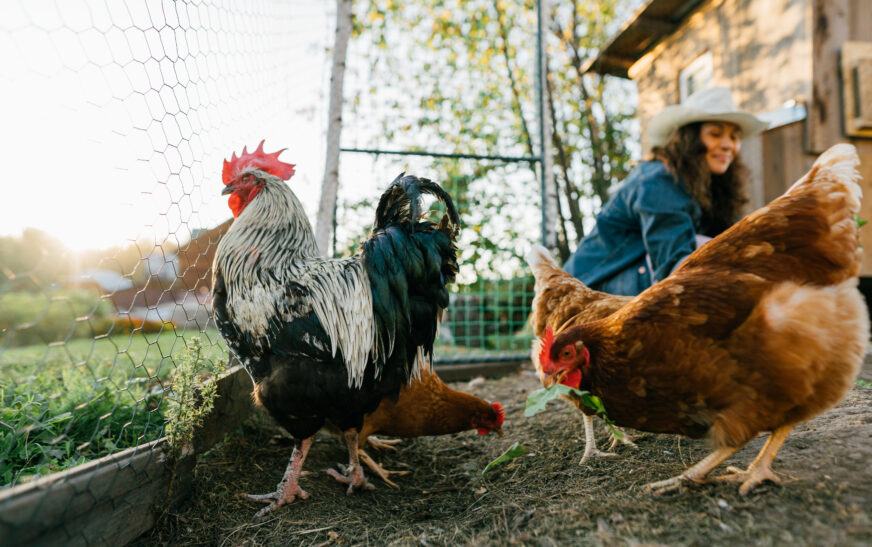
Chickens are beautiful animals and a very productive livestock for any farm owner. Having chickens in the backyard is an interesting activity for both farmers and families that are interested in living off the land. To make sure that your backyard chickens produce maximum eggs, follow the guidelines below.
How to Choose the Right Chicken Breed?
There are several types of chickens depending on their purposes and breeding. They differ by the level of egg production, meat, and feather quality. The most popular backyard breeds are layers – Rhode Island Red, Leghorn, and Australorps; dual-purpose breeds – Plymouth Rock, Sussex, and Orpington; ornamental – Silkies, Polish, and Araucana.
If you want to raise chickens in your backyard, then layer breeds will fit perfectly. This type produces eggs, is relatively calm, friendly, and good-natured. If you have space enough for raising a lot of chickens, then dual-purpose breeds will be an excellent choice for your farm.
Layer Breeds
These chickens lay eggs, are calm and gentle, and live in harmony with other fowls.
Dual-purpose Breeds
This category combines meat-producing and egg-laying hens that are good for slaughtering.
Ornamental Breeds
This category includes exotic breeds with unusual feather color and shape.
Build a Coop
It is important to take care of chickens properly and provide them with food and water. However, the most significant thing is to create a cozy place for your feathered friends to live and lay eggs. It is a necessary structure where birds can feel comfortable and safe. Building a chicken coop is not that complicated, even for beginners in carpentry. The only thing you need is patience and desire.
Size
The size of the coop depends on the number of chickens and their breeds. On average, one bird needs 2-4 sq ft of space to move freely. The structure must have enough ventilation because chickens breathe heavily and generate a lot of carbon dioxide. As a result, they may suffocate inside. That is why it is recommended to have 1/8-1/4 sq ft per bird.
It is also important to make a coop predator-resistant. Hawks, foxes, cats, dogs, raccoons, and other animals are very dangerous for chickens. It means that you should make a fence and put wire mesh on top.
Coop Design
To build a chicken coop, you need to collect material and tools. First of all, think about a design and layout. There are a lot of variants how to build a coop. You can use an existing barn or shed as a base, buy a ready-made house for birds, or construct a new coop from scratch. Some popular options include A-frame and hut-style coops. They have a spacious interior and are easy to construct.
Chicken Coop Placement and Design
The best position for a coop is sunny and well-shaded. Ideally, it should face south to receive maximum sunlight. Chickens should have shady spots inside to stay cool during hot days. Do not forget that the coop should be placed in elevated areas. Low-lying spots become a habitat for mosquitoes and cause infections.
When designing a coop, remember about the following details:
Windows are a source of natural lighting and ventilation. They must be oriented towards the south, and you can add more openings to the south side of the coop.
Doors must be wide enough to clean the chicken coop and collect eggs comfortably. They can be installed in the wall or roof.
Nesting Boxes
Nesting boxes must be situated outside the coop. It is impossible to install them inside because birds will rest in boxes during the night. Moreover, it is better to place boxes in rows.
Food and Nutrition
Nutrition is essential for healthy and vigorous chickens. Therefore, you need to pay attention to this detail. Chickens eat almost anything. It can be layer feed, grains, vegetables, and fruits. However, they prefer layer feed because it contains all vitamins and minerals necessary for laying hens.
In addition, you can give your feathered friends treats in the form of fruits, vegetables, and cereals. Such a menu can be changed regularly because there is a high risk of indigestion and infection. The most popular treats are apples, carrots, beets, kale, and spinach.
Egg Production
One of the main goals of keeping chickens in the backyard is obtaining eggs. It is not hard to make hens produce as much eggs as possible. All you need to do is to provide them with the best conditions for laying eggs.
Breed
There are many layers in the poultry industry, but the best breeds are Orpington, Rhode Island Red, Plymouth Rock, and Australorps. They produce more than 300 eggs annually.
Nutrition
Nutrition is another factor that affects egg production. As a rule, hens that consume layer feed have high egg production.
Conditions in the Chicken Coop
All chickens should have comfortable conditions. In other words, the coop should be spacious, ventilated, clean, dry, and warm.
Collect Eggs
You should collect eggs daily or twice a week. Try not to leave eggs inside the coop for a long time because they can get dirty and spoil. Afterward, wash your hands carefully and collect eggs gently. Remember that rough handling can cause cracks.
Predators Protection and Safety
Chickens are prey animals, and they are vulnerable to various animals that eat meat. Thus, you should protect your feathered friends from predators. They can be different: hawks, foxes, cats, dogs, rats, raccoons, skunks, snakes, owls, and even humans.
Predators Protection Methods
Here are the main ways to protect your chickens from animals:
Fencing – This method is suitable for protecting chickens from terrestrial predators. You should encircle the coop with a fence, and the height should be 40 inches or more. The fence will prevent animals from entering the chicken coop and attacking birds.
Wire Mesh – Cover the chicken coop with wire mesh. The wire mesh will not allow animals to fly into the coop and kill hens.
Chicken Wire – It will help protect the chicken coop from predators. This material is made of steel wire that creates a grid-like structure. The holes between the wires are narrow and do not let animals enter the coop.
Health and Hygiene
It is essential to take care of your chickens’ health. For example, you should vaccinate chickens against various infections. Besides, you should treat hens against parasites and monitor their weight. In addition, you should clean the chicken coop regularly to prevent the accumulation of bacteria. Also, you can use natural repellents to deter insects from your farm.
Biosecurity Measures
Biosecurity is vital when keeping chickens in the backyard. Here are the main biosecurity measures:
Hygiene and Sanitation – Wash hands and wear gloves when working with poultry.
Disinfectants – Clean and disinfect the coop.
Deworming – Regularly deworm chickens and treat them against parasites.
Health Management – Monitor the health status of birds regularly.
Getting Started
To raise chickens, you need to take several preparatory steps. Firstly, find out more about different breeds. Then, make a sketch of a coop and prepare construction materials.