
Meta: Learn how to train a puppy at home with our comprehensive guide, covering housebreaking, obedience, socialization, and more.
The training process seems quite complicated for many dog owners who have just received their puppy. Curiosity and abundant energy could confuse even an experienced trainer. Nonetheless, the right approach and some useful advice can help you teach your puppy and get the perfect companion.
Key Concepts and Background Information
The age of puppies from 8 weeks to 16 weeks of age demands particular attention from their owners due to their special needs. The thing is that during this period, they develop personalities, do not have all the necessary skills, and do not know much about their environment. Hence, it is important to pay specific attention to their education so that they could turn into perfectly obedient dogs in the future.
The concept of socialization is critical to consider when educating puppies. Through it, dogs are taught appropriate behavior in relation to others and different situations. Thus, socialization helps to form a harmonious personality and avoid any problems in the future. Moreover, it should be started before puppies are 16 weeks old because they might be afraid of strangers or exhibit aggression.
Teaching Housebreaking
Teaching housebreaking is rather challenging for puppy owners. To avoid difficulties and make this process easy for you and your puppy, follow the scheme below:
Designate a place to relieve himself. Find the spot outside where your puppy will defecate and urinate. At the same time, select the place inside in case he will not be able to go outside to relieve his needs. It should be close to the door.
Form a habit. Puppies have small bladders; hence, they have to urinate and defecate very often. So, establish some schedule and take him to a designated place several times a day, especially after food, walks, playtime, and sleep.
Notice his signals. Normally, puppies display signals that mean that they are ready to urinate or defecate. For instance, they sniff the floor or walk in circles. When you notice the mentioned signs, take him outside to prevent unwanted accidents.
Reward your puppy for proper behavior. Give him some snack or praise for going to a specific place to relieve himself.
Teaching Obedience Skills
Training obedience is also essential since puppies need to be obedient to commands and perform corresponding actions. In order to train them effectively, you may use the following approaches:
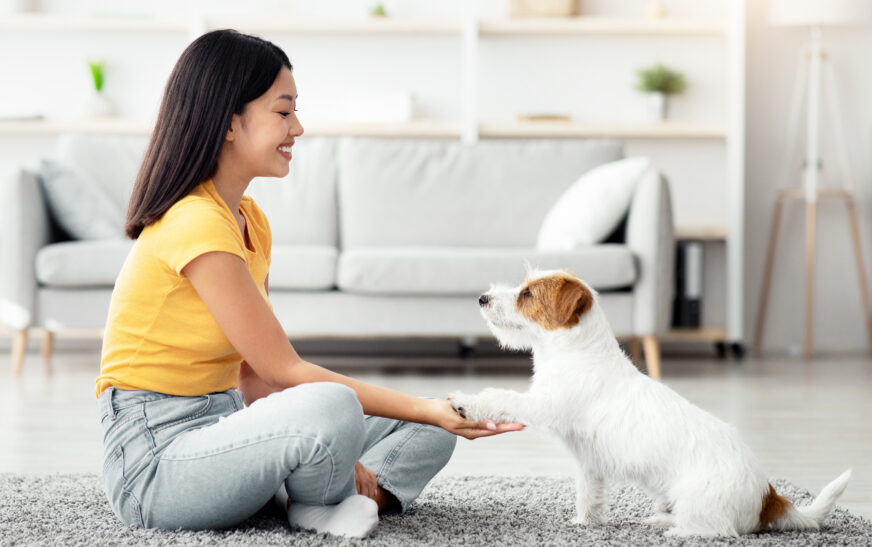
Work with basic commands. Firstly, work with basic commands, such as "sit", "stay", and "come". As regards "come", luring with a snack works well.
Reward your puppy for obedience. Rewards are crucial to encourage puppies to perform commands.
Consistency is critical. Use only one command to train the puppy to perform the required action. Otherwise, he might feel confused.
Practice every day. It is necessary to train your puppy at least once per day. It means that you have to spend a lot of time on practice.
Teaching Social Skills and Exposure to Novel Environments
Teaching appropriate behavior in diverse environments and interacting with other individuals and animals is also necessary. To do so, you may employ the following techniques:
Expose your puppy to different environments. Start introducing him to parks, malls, and different kinds of transportation. However, pay attention to his emotions since he might be scared of something. Start with small visits and then gradually increase them.
Introduce your puppy to various people. It will help him to be tolerant of different individuals and develop appropriate behavior.
Introducing different animals to your puppy. Take your puppy to see other dogs, cats, and other animals. Ensure that he gets along well with them.
Addressing Separation Anxiety
Finally, separation anxiety is another problem that might occur during puppy training. To cope with it, you may apply the following strategies:
Start with gradual separations. It is important to start with brief separations and then make them longer and longer.
Leave some of your things with your puppy. For example, leave one of his toys with your smell.
Use mental stimulation. Engage your puppy in activities that stimulate thinking.
Use crating techniques. Crating allows preventing unwanted accidents when you leave the puppy alone.
Conclusion and Recommendations
In conclusion, I would like to point out that it is possible to train your puppy if you apply the methods listed above. Nonetheless, you may face some difficulties or challenges. If it happens, ask professionals for help