

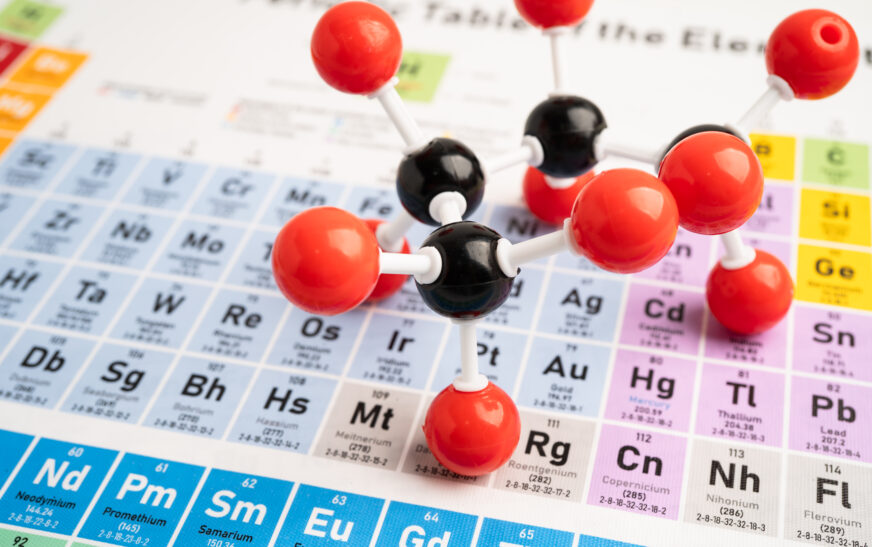
The universe is composed of numerous different elements, some of which include atoms and molecules, which are considered the smallest elements. The field of atoms and molecules study is the very first step into studying physics and chemistry. Therefore, it is important for all people interested in sciences. Although sometimes it might not be quite easy, this field is interesting and fun because it gives a lot of insight into nature and helps people know more about the world and universe.
Atoms – Basic Information
At least basic information about atoms should be provided before moving on because atoms are the core of studying chemistry. An atom is considered to be the smallest component of a substance. It comprises of three elements including protons, neutrons, and electrons. Protons and neutrons compose the nucleus, whereas electrons are located around it. It is necessary to note that protons are what determines what an atom is because the number of protons indicates the element. Neutrons do not influence the composition of the element, but their number determines the isotope of the element.
Atoms are tiny. In most cases, they have sizes measured in picometers or femtometers. However, they are important for the human life due to how they react with other atoms or molecules. This means that understanding atoms is crucial because they are present everywhere in the universe, forming literally everything.
Types of Bonds Between Atoms: Basic Knowledge
One of the main features that distinguish atoms from other elements is that besides being able to exist separately, they also can combine with other atoms and molecules, forming bonds. In other words, a molecule can be formed by the number of atoms needed to be connected. For example, a molecule of water includes two hydrogen atoms and one oxygen atom. Water is considered to be a triatomic molecule.
Moreover, there are numerous kinds of bonds that determine the state of a molecule. Thus, molecules can exist as a diatomic gas (e.g., hydrogen, chlorine), as a polymer (e.g., proteins, nucleic acids), ionic molecules (e.g., sodium chloride), etc. Therefore, learning about molecular bonds and different kinds of them is a great opportunity to learn more about chemistry and physics.
Molecule – Basic Characteristics
As was mentioned above, molecules are created out of bonding atoms; however, they have certain characteristics depending on what kind of atoms form them, the type of bonds, and the number of atoms in a molecule. Thus, knowing these aspects, it is possible to understand better the structure of a molecule. For example, the simplest molecule of water has one oxygen atom and two hydrogen atoms. They form a connection due to the presence of covalent bonds; thus, water molecules are polar because there is a dipole moment and polar bonds. The oxygen molecule has a negative charge whereas hydrogen has a positive charge.
Interactions of Atomic or Molecular Entities: Forces and Energies
In addition to possessing a set of certain characteristics, it is necessary to mention that atoms can interact with other atoms and molecules through various forces that define the features of substances formed due to these interactions. That is why it is crucial to understand various types of forces and energies including electrostatic forces, van der Waals force, and chemical bonds, etc.
Electrostatic interaction is determined by the charge of two interacting elements and their distance from each other. Thus, when two negatively charged particles are interacting, the attraction is repelling them apart. On the contrary, when two positively charged particles are involved, the electrostatic interaction is attracting them together.
Why You Should Learn about Atoms and Molecules
Knowing about atoms and molecules is beneficial for those who are interested in chemistry and physics. The reason behind this is that atoms and molecules lay the foundation for the existence of all substances and all processes occurring within them, including chemical reactions and biological reactions. Therefore, it is crucial to understand these spheres for getting a deeper understanding of the world.
For instance, learning about the properties of molecules can be helpful for developing new medications for different diseases. In order to find weak points of the pathogens causing specific illnesses, it is required to understand molecular compositions. In addition, understanding the properties of materials can help to develop new technologies and innovations.
Where and How Can You Learn About Atoms and Molecules?
There are a number of resources and tools that can be used to learn about atoms and molecules. First of all, there are textbooks and websites dedicated to these topics. One of the examples of such websites is NCBI or Royal Society of Chemistry. Moreover, there are a number of courses, available online and on YouTube (for example, 3Blue1Brown). In addition, there are applications that allow people to learn more about atoms and molecules.
Various simulation tools, such as Discovery Studio, Jmol, and PyMOL enable users to create molecular models and modify them according to specific conditions. In addition, such software as Avogadro enables the simulation of various chemical interactions including chemical reactions.
Conclusion
Learning about atoms and molecules plays an extremely important role since atoms’ and molecules’ properties determine material behavior; that is why it becomes possible to create new innovations and discover new therapies. Studying these spheres is not always simple and requires efforts from a person; however, there are plenty of advantages a person gets after learning about these spheres. Therefore, start right away!