

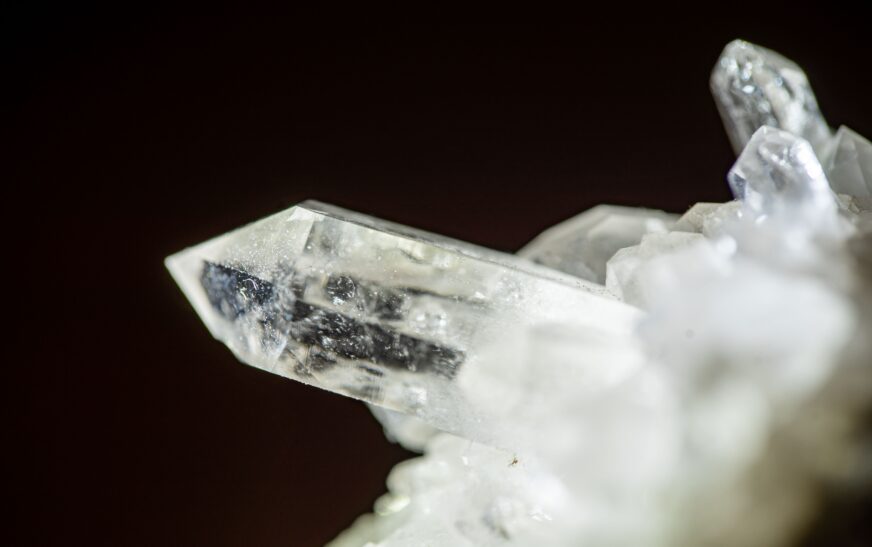
Crystals have always been fascinating objects of nature. People have studied various aspects of crystals since the times of antiquity, both spiritually and scientifically. The study of various types of crystals and their formation would certainly intrigue people of various interests, regardless of whether it is a practitioner of crystal healing or just a fan of science. In this article, the process of crystallization is discussed further on along with providing some key facts about it.
Types of Crystals
This area of knowledge studies minerals. To date, over 5000 different minerals have been identified. These substances are inorganic compounds which occur naturally on the Earth’s surface. In most cases, minerals have a crystalline structure, which makes them have specific qualities and features. As for crystallization itself, it is a unique phenomenon where atoms and molecules join into a stable repetitive structure called crystal lattice. Taking this into account, two types of crystals can be distinguished depending on what substances are involved in the formation process: organic and inorganic.
Basic Terms: Crystal Lattice, Lattice Energy, and Crystal Growth
To better understand the processes connected with crystal formation, it is essential to become familiar with some basic notions such as crystal lattice, lattice energy, and crystal growth.
Geological Processes: How Crystals Are Formed
Various processes occur in nature, as a result of which crystals form. Specifically, three geological processes are known. These processes are magmatic, metamorphic, and sedimentary. The first process implies cooling of magma followed by the formation of crystals. Quartz and feldspar can be formed through this process. As for the second process, when crystals such as marble or slate are formed due to rocks being subjected to extreme temperatures and pressures. Finally, in the course of sedimentary process, crystals such as sandstone or dolostone are formed due to the process of sediment compression.
However, apart from the abovementioned geological processes, crystals can be formed through hydrothermal process implying interaction between rocks and hot water. As a result, various crystals are created including pyrite and calcite.
How Temperature and Pressure Affect Crystal Formation
Two main aspects that influence the growth of crystals include temperature and pressure. In case of high temperature, a rapid formation of crystals occurs, which results in having strange forms of crystals. If low temperature prevails, then crystal formation slows down, and there appear smaller and evenly shaped crystals. As for high pressure, it causes the compression of the crystal lattice, resulting in no further development of the crystals. However, under the conditions of low pressure, crystals grow rapidly and become large and have complicated forms.
The Impact of Chemical Composition on the Growth of Crystals
A number of factors can influence the growth of crystals. One of the most influential ones is the chemical composition. Depending on it, a mineral obtains certain properties, including physical and chemical. For instance, such mineral as quartz has high resistance to weathering, whereas halite has a low level of such resistance. Some minerals can be defined as dense minerals (calcite and aragonite), and they can be applied in construction works.
By knowing about chemical composition of a crystal, it is possible to know more about its optical properties. For example, having a high refractive index is typical for minerals such as diamond and quartz, making them sparkling. At the same time, minerals such as sapphire and ruby have a low refractive index and, therefore, a rich color.
Crystal Structure: Its Importance
It is worth mentioning that crystal healing was practiced already in ancient times, and people could describe the properties of various crystals. Thus, it is essential to study the properties of mineral today, as well, in order to see their impact on health and the state of mind of a person. In this respect, it is necessary to mention polarizing crystals such as amethyst and quartz. There are also some crystals that calm a person such as calcite and selenite.
Moreover, some minerals stimulate positive emotions such as love and affection; rose quartz and pink tourmaline belong to this category. Finally, certain minerals have protective properties, namely, black tourmaline and obsidian.
Conclusion and Call for Action
Thus, this article covered different aspects of crystal formation. It can be concluded that studying mineralogy in general is interesting both for scientists and common people. Hence, it would be a good idea to learn more about minerals. Here are some pieces of advice for people who want to explore this field further on.
* Visit the nearby mineral museum and look at different types of minerals;
* Find useful information online via various mineralogy websites and crystal database;
* Become part of the crystal practitioner community to make acquaintances with people.
With this article, it should become clear to you how crystals form.