
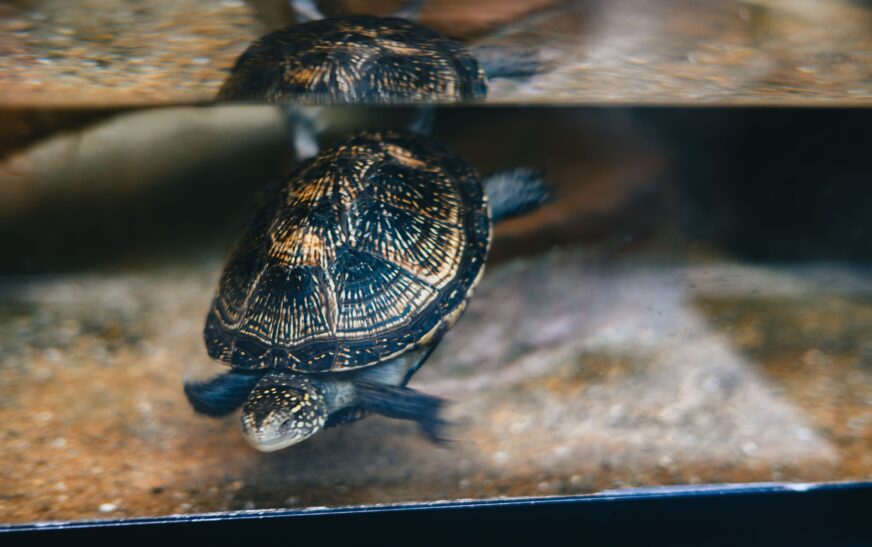
Looking after a pet turtle is quite exciting. Nevertheless, in order to do it correctly, a person will have to put some efforts into it because the animals need special conditions for living. Primarily, you should be aware that there are over 300 turtle species and each of them has particular features. Hence, you have to conduct research in order to find out more about the peculiarities of the care for a certain species.
Creating a Good Habitat
In the first place, it is important to choose a comfortable place for your new pet. In this way, you will ensure its longevity and happiness. A 20-30 gallons aquarium is an excellent solution suitable for almost all kinds of turtles. There you will have to create a favorable habitat for it using several rules.
The main thing is to choose the appropriate substrate, which should not contain such elements as sand and gravel. The reptile carpet or paper towels can be used for this purpose. Additionally, you can put some decorations like plants, rocks, and driftwood inside.
Feeding Your Pet
It should be kept in mind that most kinds of turtles are omnivores that need various types of food. Turtles’ pellets, vegetables, fruit, as well as protein-based foods, can provide the turtle with everything required for staying healthy.
To provide your pet with adequate nutrition, it is crucial to give it three essential ingredients: calcium, Vitamin D3, and protein. The first two components will help to develop properly by maintaining normal blood clotting and regulating calcium levels in the bloodstream. Meanwhile, the latter is required for bone and muscle growth. These substances can be found in turtle food of high quality.
Maintaining Appropriate Temperature Levels
As far as temperature is concerned, it is important to control the situation because it affects the turtle’s life negatively. In this connection, the temperature gradient should be maintained in the aquarium through providing the turtle with a heating element located in one corner. Thus, the turtle will always be able to bask in the warm area without being in any risk. As for temperature levels in the majority of species, it can vary from 75 to 85 F° and 65-75F°. Heat lamps and ceramic heat emitters will be helpful in this case.
Checking the Health Condition
Health checks cannot be overlooked when caring for a turtle because it will allow you to notice all existing issues and provide timely treatment. The main factors to be considered are the change in appetite and behavior as well as breathing difficulties. Apart from this, it is also necessary to check stools and urine in order to find any infections there.
While conducting health checks, you will have to pay special attention to your turtle’s appearance. It means that apart from observing the turtle, you will have to examine its body, head, ears, and shell carefully. A healthy turtle looks bright-eyed and has a clean shell. If there are any doubts, you should visit a veterinarian.
Creating the Right Conditions for Living
A turtle requires good conditions that will allow it to feel great at all times. In this way, it is vital not to place it near any windows or direct sunlight that might do harm. Besides, you will have to ensure that your pet is in safety, which means that the tank should be placed appropriately.
When holding your turtle, you should be very careful because these animals get stressed easily. What is more, before handling it, you will have to wash your hands to prevent any infections. Excessive handling will contribute to the emergence of health problems.
Useful Information
Apart from above-mentioned information, it is crucial to provide your turtle with access to water for soaking and swimming. You can use a water conditioner for getting rid of the chlorine and chloramines. In addition to it, it is recommended changing the water regularly. Moreover, you should create some hiding spots for reducing the level of stress.