
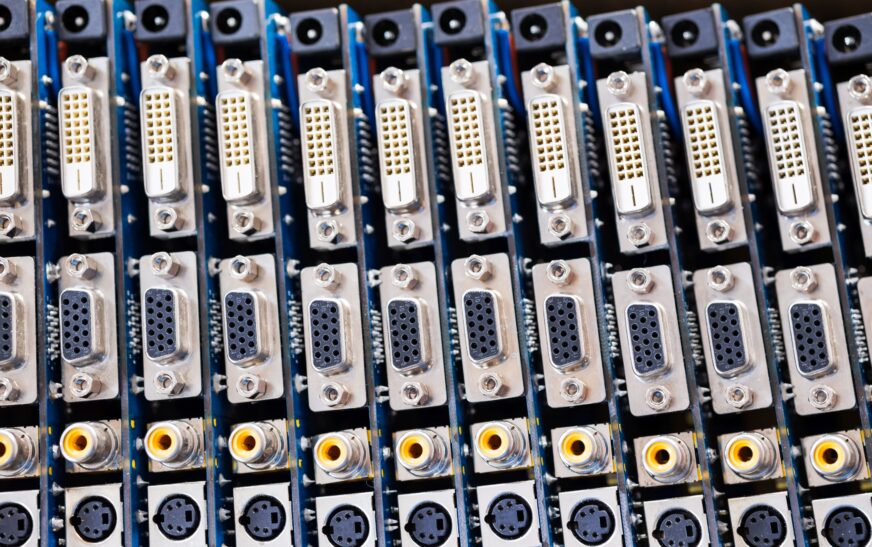
With all today’s conveniences, we have forgotten about parallel ports, which used to be the main communication interface between computers and peripheral devices. Though now they are not as popular anymore, learning the basics of parallel data transmission will help to understand the evolution of computers better.
Here we are going to cover some important aspects of parallel ports, including their definition, origin, working principles, evolution stages, and why they disappeared in favor of some others.
What Is a Parallel Port
A parallel port is a kind of interface enabling the transfer of multiple bits of data through separate channels simultaneously. In contrast to serial data transmission, a parallel interface is capable of sending data in groups.
This particular type of transmission was essential when designing the first personal computers due to the need for quick connection to printers or other external devices.
The History of Parallel Ports
At first, IBM decided to invent a parallel port specifically because there appeared a need to make personal computers compatible with printers made by the company Centronics. In the course of their development, the company came up with the following design combination:
a 25-pin DB-25 connector on the computer side
a 36-pin Centronics connector on the printer side
It entailed that the company had to make a dedicated cable to connect these two types of connectors together. The IBM PC, which had been first presented in 1981, set the trend, and soon all the other companies followed suit.
How Does Parallel Data Transmission Work
The main feature of the parallel port is its capability to transfer 8 bits of data simultaneously.
In other words, it transfers 1 byte at a time by means of sending 8 bits through separate conductive lines (pins). This process is referred to as parallel communication. Thanks to that, it can achieve transfer rates of up to 150 kilobytes per second. Quite efficient, isn’t it?
Moreover, the information transferred by means of a parallel port is presented in a rather simplistic format:
5 volts represent binary 1
0 volts represent binary 0
That is how the computer was able to transmit its digital data in the form of an analog signal.
Main Types of Pins Used in a Parallel Port
There are many pins that perform certain functions when you connect your computer with the printer. Here are some major roles these pins play when your computer is connected to the printer:
Pin 1 (Strobe) tells about transferring data from the computer to the printer
Pins 2 to 9 transmit the actual data bits
Pin 10 (Acknowledge) confirms receiving of the transmitted data
Pin 11 (Busy) indicates that your printer needs more time to receive the data
Pin 12 (Paper Status) informs your computer that the printer is out of paper
Pin 13 (Online Status) tells that everything is OK with the connection and the printer is ready to get data
Pin 14 (Auto Feed) controls automatic line feed in the printer
Pin 15 (Error) tells that something went wrong in transferring of data
Pin 16 (Initialize) serves for printer reset or initialization
Pin 17 (Select) takes the printer off-line
Pins 18 to 25 are grounding pins providing a ground level for electric signals
From Unidirectional to Bidirectional Parallel Port
Initially, all parallel ports were just unidirectional, i.e., capable of transferring data in one direction. The situation changed dramatically when the IBM PS/2 introduced bidirectional mode, called the Standard Parallel Port or SPP, in 1987.
In this case:
the computer can send and receive data through this port
parallel communication becomes much more versatile
it works great for advanced devices
however, the early models of bidirectional parallel ports usually operated in a half-duplex manner, thus transferring data in one direction at any point of time.
Advanced Standards for Parallel Data Transmission
Along with the time going, new standards for transferring data through parallel ports appeared.
Enhanced Parallel Port (EPP)
In 1991, some leading computer equipment manufacturers decided to make parallel port even more efficient by developing EPP standards. The following are among the characteristics of that standard:
transfer rate up to 500 KB/s to 2 MB/s
this mode works best for peripheral devices other than printers, for example, for storage devices
minimal involvement of processor resources in transferring of data
Thus, this parallel port standard makes possible to use this port for non-printer purposes.
Extended Capabilities Port (ECP)
One more advanced version of a parallel port was invented by Microsoft and Hewlett Packard in 1992. It got the name ECP due to its advanced capabilities, mainly concerning printers. Here are the main features of ECP:
fast data transfer
support of data compression
direct memory access (DMA)
Thus, ECP enabled printers to perform many more functions with the assistance of a computer.
IEEE 1284 Standard for Parallel Ports
In 1994, the standard IEEE 1284 for parallel ports became available. As a result, several kinds of parallel ports can be distinguished depending on their operation modes:
Standard Parallel Port or SPP
Enhanced Parallel Port or EPP
Extended Capabilities Port or ECP
To make it work, the computer and the external device must support the same kind of standard.
Why Did Parallel Ports Become Outdated
Nowadays, parallel ports are not so common, because they have been replaced with some others. The advantages that new kinds of ports have include the following:
more compact and easy-to-use connectors
higher transfer rates
versatility concerning the types of connected peripheral devices
plug-and-play technology
simplification of the cables
Though now there are adapters for connecting a printer to a computer via a parallel port, it is hardly used.
Final Conclusion
Parallel ports made a great contribution to the development of personal computing. With their help, we have managed to provide effective connection between computers and various peripheral devices until the appearance of USB ports and their further domination.