
Volcanic eruptions might remind one of the impressive and terrifying power of Mother Nature. These natural phenomena are usually associated with the formation of mountain ranges, but what is the process that leads to volcanic eruptions? There exist several methods to recreate the process of a volcano creation. A simple experiment with household materials can provide some interesting insights into this phenomenon.
Experiment with Household Materials to Understand the Creation of a Volcano
A simple volcano experiment can be conducted with the help of common materials. To recreate the volcano formation process, one needs such ingredients as baking soda, vinegar, clay, a plastic bottle, and something to catch the "lava". A plastic bottle will be used as a substitute for a real volcano. The baking soda will react with the vinegar; therefore, one will observe an interesting chemical process.
Build-up the Volcano Structure
At first, one should cut a plastic bottle in order to form a crater. Then, cover the opening and sides of a bottle with the clay; thus, a mountain will appear. The crater is important since its volume should correspond to the ratio of baking soda and vinegar. In addition, one should be careful in constructing the volcano because too much baking soda or vinegar may lead to unexpected results.
Create a Mixture of Ingredients
To make the volcano erupt, one needs to create two mixtures of the selected ingredients. Thus, to prepare the baking soda, add 2-3 tablespoons of water to it. At that, the substance will become more viscous. In order to produce the vinegar mixture, combine 1 cup of vinegar with 1 cup of water.
Understanding the Reaction Between the Substances
The reaction that will occur between the baking soda and vinegar is well known for many people. However, it does not mean that everyone understands this chemical process. The matter is that these substances are a base and an acid, respectively; their interaction leads to the release of carbon dioxide gas. It should be stressed that this gas causes the eruption.
Creation of a Volcanic Eruption with Household Ingredients
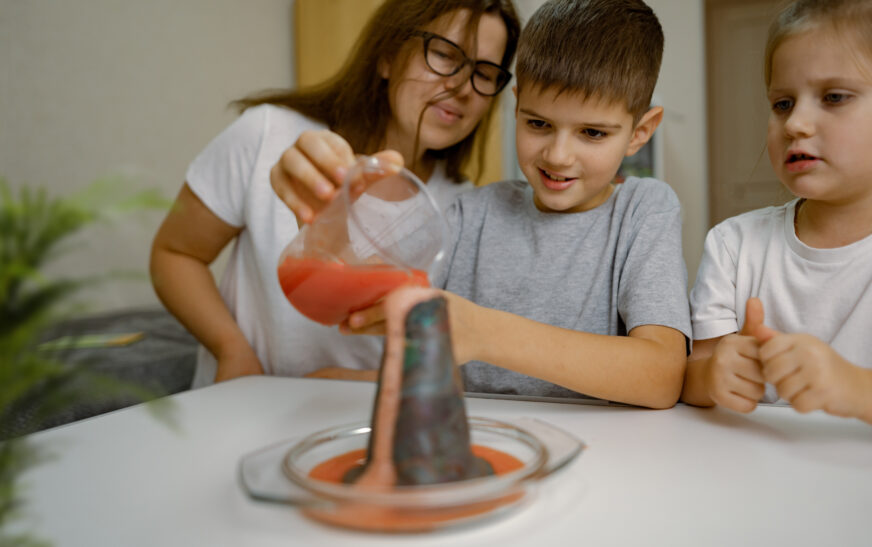
In order to create an eruption, pour the vinegar mixture into the prepared volcano’s crater. Since the substances begin to interact immediately, the volcano erupts. In other words, the lava begins to run down the slopes of a mountain. The rate and intensity of an eruption depends on the amount of substances used. In order to achieve the required effect, change the ratio of baking soda to vinegar.
Add More Color and Textures to the Experiment
As mentioned above, the baking soda reacts with the vinegar to produce an eruption. However, the reaction can be made more spectacular by adding a few more elements to a volcano. For instance, a few drops of food coloring may be added to the baking soda to make the eruption look like real lava. Besides, a few drops of dish soap may be used to increase foaming.
Construct a Realistic Volcano Landscape
As was mentioned before, a volcano consists of the structure and the area where a volcano is located. One may easily construct the second part of a volcano. It is enough to add some stones or sands around a plastic volcano to make the structure look more natural. In order to get more impressive results, add a tiny bit of clay or papier-mâché to the created landscape.
Conclusion and Reflections
It can be said that an impressive volcanic eruption can be created by means of household materials. The main ingredients that are required to produce an eruption are the baking soda and the vinegar. The volcano structure must be created in advance; thus, it is possible to control the whole process of volcano creation.