
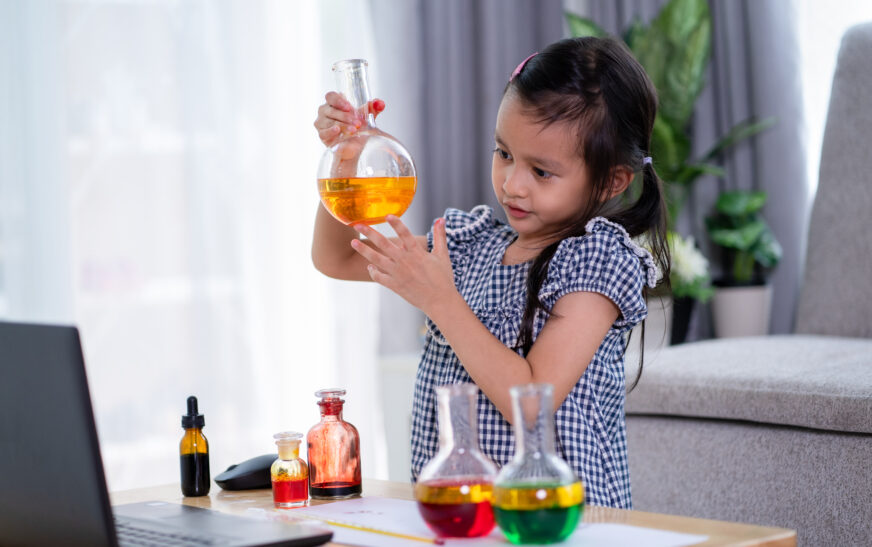
Experimenting at home is a fantastic approach to developing practical skills in science. Not only will students learn more about various concepts in physics, chemistry, or biology; they can also engage their imagination to develop new experiments. With proper planning, it becomes possible to create a simple science experiment and explore interesting topics. While some students can struggle to find a suitable topic for research, the article below can guide them through the selection process, planning, conducting, and analyzing the results.
Choosing the Experiment
The selection of a particular experiment is one of the most difficult steps in its creation. In addition to the interest of the topic, a student must ensure that it is safe to perform, affordable, and not too complicated. Therefore, the first stage of developing a simple science experiment is choosing the right topic. Students should select an interesting area and consider how much time they would spend creating their project. The experiment should not exceed three hours.
For instance, one of the most famous and popular science experiments is the density column. Using several liquids of different densities, one can build a tower in a transparent tube. Such an experiment does not require special equipment and materials, which makes it perfect for beginners.
Gathering Materials and Equipment
After selecting the experiment, a person should collect all necessary equipment. Depending on the selected topic, a student should buy specific materials for his or her project. Sometimes, a simple experiment can require expensive or rare tools, which may prevent people from completing their projects. In such cases, a student needs to change the theme of the research to make it simpler and less costly.
In the case of the density column, people would need to purchase only a few materials. It is crucial to find a tall clear tube (e.g., a test tube), a large amount of water, vegetable oil, and a few drops of food coloring. Additionally, it would be wise to gather some extra materials (e.g., a syringe). These materials could come in handy during an emergency situation.
Conducting the Experiment
The third stage involves the actual execution of the experiment. At this point, a student starts the procedure of testing their hypothesis or theory. As soon as a person obtains their results, he or she can move on to the next stage of the process. During this stage, it is vital to use necessary protective equipment and follow the safety instructions provided by a teacher or professor.
First, one should fill the test tube with water, leaving about a quarter of space above the surface. After that, people can color this liquid, adding some food coloring to make the experiment more attractive. Finally, one can pour the vegetable oil into the tube. Since the liquids have different densities, they can float independently without mixing.
Analyzing and Interpreting Results
The final step in developing a simple science experiment is analyzing and interpreting the findings. This stage is vital for understanding the essence of the experiment and learning new scientific principles. While working with results, a student should focus on factors like variables, the outcome, and the possible errors made throughout the process.
For example, a student can analyze the density of two liquids, as well as their interaction inside the tube. People can experiment with different types of liquids, finding those that would float without mixing. In addition, one can measure the speed of separation and determine whether certain liquids can combine.
Tips and Variations
While creating a science experiment, students should consider some tips and variations. In particular, people should always use necessary protection when dealing with hazardous substances. Besides, it would be wise to follow the instructions of the teacher or professor while creating an experiment. Lastly, a student should not be shy to contact their professor for consultation if needed.
As for variations in the experiment, people can try to use different forms and shapes of tubes. Additionally, they can experiment with various liquids, trying to find those that would form a unique density column. Moreover, people can add a few drops of vegetable oil to water to observe unusual chemical reactions.
Conclusion and Future Experiments
When concluding the work with a simple science experiment, a student should summarize their results and describe the main insights gained. Such a conclusion helps one understand whether they achieved their goals and discovered new things in the selected field. After finishing the experiment, a student can proceed to the next project and study other areas of science.
Since there are thousands of science experiments and projects, students never run out of topics. Regardless of the difficulty, people can explore any issue in physics, chemistry, biology, engineering, or mathematics. Even though some experiments can be dangerous and require special equipment, others can be conducted at home.