

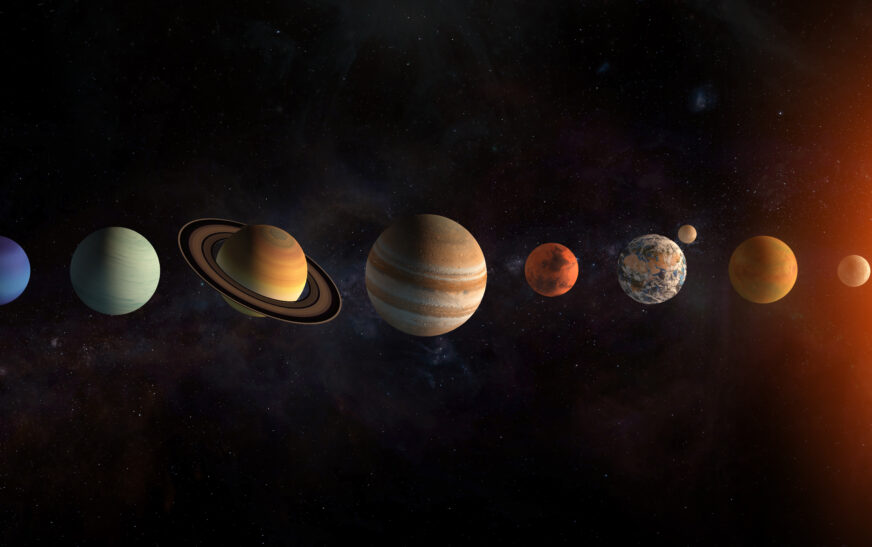
Exploring the solar system may appear complicated because it is a broad topic; however, one can easily understand how it works by looking into some of its basic elements. Studying the various planets and their unique features, the sun, and other elements in the solar system will help individuals learn more about this magnificent creation in space.
Understanding the Basics of the Solar System
First, it is essential to understand what the solar system entails. The solar system contains eight planets, five dwarf planets, several moons, asteroids, and comets. Located at the heart of the solar system is the sun – a gigantic ball of hot, glowing gas that provides both light and warmth to all the planets. To get a better grasp of the Solar system, individuals must understand the basics of the sun first.
The Eight Planets of Our Solar System
There are eight planets located in our Solar system; however, each of them has unique features that make them stand out from each other. From the first through the eighth positions from the sun, there are Mercury, Venus, Earth, Mars, Jupiter, Saturn, Uranus, and Neptune. The first four planets, i.e., Mercury, Venus, Earth, and Mars, are known as the inner planets, while Jupiter, Saturn, Uranus, and Neptune are known as the outer planets.
Explaining the Inner Planets
As mentioned earlier, the inner planets consist of Mercury, Venus, Earth, and Mars. Because of their rocky composition, these planets are also referred to as terrestrial planets. As for their sizes, these planets can be described as relatively small, compared to the outer planets. In addition, the inner planets have relatively thin atmospheres compared to the outer planets. Mercury, the smallest planet in our Solar system, has a diameter of approximately 4,879 kilometers and is located at an average distance of about 58 million kilometers from the sun. Being very close to the sun, Mercury is one of the hottest planets in our Solar system. Venus is also known for having extremely high temperatures; it is often called the hottest planet in the Solar system as its surface temperature can reach 462°C. Earth is another special inner planet in our Solar system; unlike other planets, it supports life. Finally, the fourth planet in our Solar system, Mars, is the so-called Red Planet; the reason behind this name lies in its color.
Understanding the Outer Planets
As mentioned before, the outer planets in the Solar system consist of Jupiter, Saturn, Uranus, and Neptune. Unlike the inner planets, these celestial bodies are known as gas giants, meaning that they are enormous, have a thick atmosphere, and are made mainly of gas. Compared to the inner planets, Jupiter and Saturn are very massive and have relatively large sizes, with the first one being the largest planet in our Solar system (142,984 km), compared to the second one (116,460 km). Moreover, Saturn has an impressive ring system around it. Uranus and Neptune can be also referred to as the ice giants.
Explaining the Dwarf Planets
According to the International Astronomical Union (IAU), a dwarf planet is a body that orbits the sun and is too small to qualify as a regular planet. According to IAU, Pluto was not regarded as a regular planet anymore and was renamed a dwarf planet. So far, five other objects have been reclassified to this category, namely Eris, Ceres, Haumea, Makemake, and Sedna.
The Moons of the Solar System
Like planets, every planet in our Solar system has several moons. Some of them are big, whereas others are rather small. Among all the moons, the biggest one is named Ganymede; it belongs to Jupiter and has the diameter of approximately 5,262 kilometers. The moon with the most impressive feature is Titan, which belongs to Saturn and has a thick atmosphere and methane lakes. Finally, the moon that has an unusual feature is Europa that also belongs to Jupiter and has an ice surface and an underground ocean of liquid water.
Importance of the Solar System in Our Lives
It would be quite difficult to imagine living without the sun because we need light and heat that comes from it every day. Besides, the planets located in our Solar system create a unique neighborhood in space.
Exploring the Solar System Further
In conclusion, exploring the Solar system implies understanding its elements and getting familiar with some of its important details. Individuals should pay attention to the Sun as well as learn more about the various planets in the Solar system.