
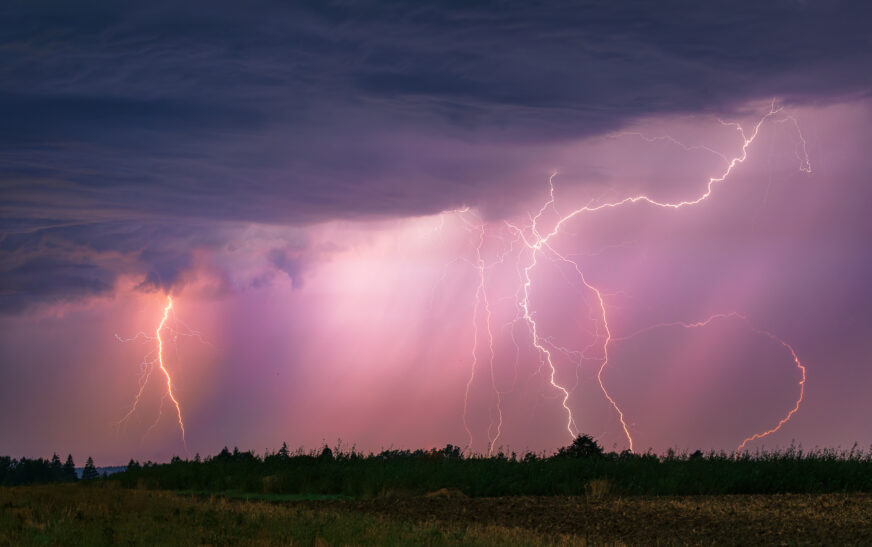
Have you ever gazed at the beautiful scenery of lightning in the sky and wondered how it occurs? The science of lightning is an exciting topic that involves the science of physics, geology, and meteorology. Much information concerning the science of lightning has been acquired by scientists for years. The science of lightning is fascinating, however, the information acquired through this scientific field is crucial in predicting and preventing risks associated with lightning.
The Formation of Lightning
A huge electrostatic discharge is formed in the sky between clouds and ground or even clouds. As warm air moves upward in the atmosphere, it meets cold air masses where water droplets and ice crystals are found, resulting in the exchange of electrons and consequently the formation of electrically charged particles. During the movement of warm air upwards in the atmosphere, there is a separation of water droplets and ice crystals into positively and negatively charged particles. Consequently, a huge electric field is created between these two electrically charged objects. There is a strong electric field between positively charged clouds and negatively charged ground or other clouds, which causes a breakdown of the air molecules. Hence, lightning takes place.
The Role of Moisture and Temperature in Lightning Formations
Moisture and temperature play a crucial role in the formation of lightning. Ice crystals and water droplets are major components of electrical charge within clouds. There is a transfer of electrons between these water droplets and ice crystals during their collision, which causes a separation of electric charge within the clouds. Temperatures and humidity levels within clouds determine the formation of lightning within clouds.
Cloud to Ground Lightning
Cloud to ground lightning is one of the commonly formed types of lightning, constituting 70 percent of lightning formations. Positive cloud, usually a cumulonimbus cloud interacts with the negative charges in the ground. The resultant electric field becomes extremely strong and creates a conductive path for lightning discharge to occur. Cloud to ground lightning is very destructive as it results in temperatures exceeding 50,000 degrees Celsius.
Intracloud Lightning
Intracloud lightning refers to the process whereby there is lightning discharge within the same cloud. About 40 percent of lightning is intracloud lightning, which involves high intensity of lightning discharge at intervals. Increased electrical activity within the cloud causes intracloud lightning.
Speed of Lightning
Lightning travels very fast, reaching a maximum speed of about 270,000 kilometers per hour. The velocity of lightning is faster than the velocity of sound waves hence the reason why you see lightning before hearing its sound. The speed of lightning is affected by temperature and humidity levels in the cloud. The speed of lightning varies depending on the type of lightning.
Lightning Rods
Lightning rods are instruments used to direct lightning safely to the ground. They are metallic poles installed in buildings or structures for protection against lightning strikes. The science behind lightning rods involves electrical attraction. Lightning rods are installed in buildings or structures as a measure against lighting strikes. When positively charged clouds discharge lightnings, the lightning rod attracts it to be safely discharged to the ground via the lightning rod.
Lightning Detection and Prediction
Lightning detection and prediction are necessary for reducing risks associated with lightning. Scientists use different technologies in predicting and detecting lightning. Some of the commonly used methods are satellite and radar imaging techniques.
Conclusion
The science of lightning is an interesting topic. Different scientific fields are involved in the study of lightning, among which are physics, geology, and meteorology. Scientists have researched about the formation of lightning for years, obtaining useful information concerning lightning. The science of lightning is fascinating and important in predicting and preventing lightning risks.