

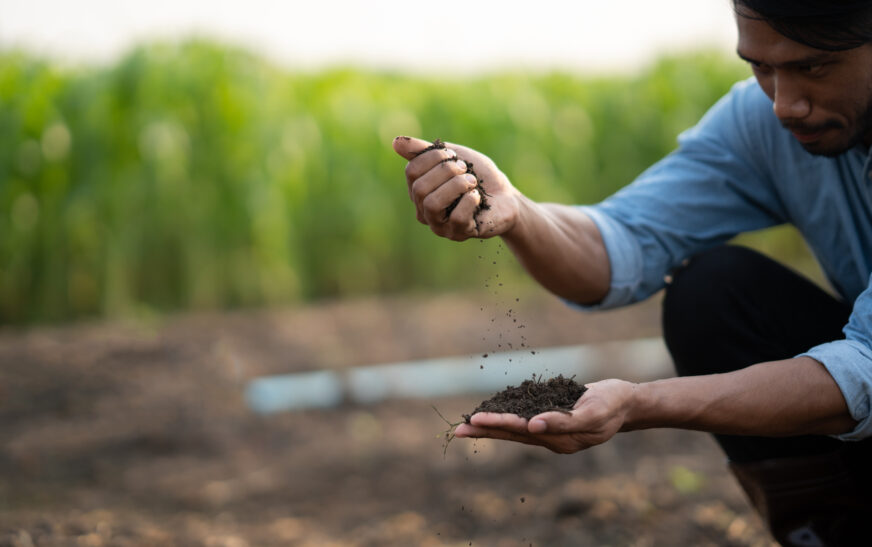
In 2023, the world’s population stood at 7.89 billion. Within the next three decades, there will be an explosion in population, raising the total number of people to 9.7 billion in 2050. As such, farmers will need to produce enough food to feed this large number of people. In order to do so, farmers will need to adopt innovative farming practices. The study of soil and agriculture involves the understanding of the relationship between soil, plants, water, and microorganisms.
Fundamentals of Soil Science
As already mentioned, soil consists of mineral and organic matter providing plants with water, nutrients, and air. It is vital for farmers to understand the science of soil in order to increase crop yield and food production. In addition, soil science can be helpful for making decisions related to the use of fertilizers.
One of the key aspects in enhancing crop yield is the knowledge about soil texture. Again, as already noted, soil is composed of mineral and organic matter providing plants with water, nutrients, and air. Depending on the composition of sand, silt, and clay particles, different types of soils are distinguished. Such types include sandy, loamy, and clay soils. Understanding soil textures can provide farmers with useful information. They can decide if the soils have enough water holding capacity according to the percentages of sand, silt, and clay particles.
Soils are classified depending on texture, level of acidity, and nutrient content. Based on these criteria, soils are divided into five types including clay soils, loamy soils, silt soils, peaty soils, and sandy soils. Clay soils are rich in minerals and consist of 40% of sand particles. These soils are used to cultivate crops such as rice and wheat. Loamy soils are rich in minerals with only little sand particles. Loamy soils are mostly used to cultivate vegetables and maize.
Silt soils are rich in organic matter and contain 60% of clay particles. They have a moderate level of nutrients. These soils are mostly used for cultivating fruits. Peaty soils are rich in organic matter with no minerals and water. They are used for cultivating flowers. Finally, sandy soils have a lot of sand particles. Farmers use them for cultivating maize and soybean.
Soil Microbiology and Its Importance
The science of soil microbiology deals with studying bacteria, fungi, and other tiny microorganisms inhabiting soils. It is an important aspect of soil science since soil microbiology affects crop yields, fertility, and sustainability. There exist two groups of soil microorganisms – pathogenic and beneficial. The first category infects crops and spreads pathogens. Pathogenic microorganisms include nematodes and fungi. On the contrary, beneficial microorganisms provide plants with nutrients while protecting them from pests and disease. They also stimulate root growth. In order to decrease the damage caused by microorganisms, farmers should adopt practices of conservation agriculture.
Conservation agriculture includes minimum soil disturbance and adding organic fertilizers for promoting beneficial microorganisms.
Importance of Water in Soil Science
Water is an element required both for soil formation and cultivation of crops. The process of moving water in soils involves movement from the surface layer to the subsoil layer. As was already mentioned above, soils may have different levels of water. Thus, studying processes involved in soil-water cycle will help farmers better understand water distribution in soils. In addition, knowledge about soil-water cycle will help farmers optimize water use.
Based on water-holding capacity, soils are classified into several categories. These include hydric and dry soils. Hydric soils are very wet and found in areas receiving high levels of precipitation. Such soils are used to grow rice and maize. On the contrary, dry soils hold very small amounts of water and occur in areas receiving little precipitation. Dry soils are mostly used for growing soybean and wheat.
Impacts of Climate Change on Soil Science
Climate change has had a great impact on soil science since the 1990s. It is important to define what climate change means since it plays an integral role in affecting soil health and crop productivity. Climate change refers to changing weather patterns owing to global warming. It has detrimental effects on the environment as it leads to the emission of greenhouse gases. Climatic conditions have a bearing on soil microorganisms, development of plants, and soil-water cycles. Moreover, climatic changes bring flooding and drought, which degrade soils.
In order to counteract the effects of climate change, farmers should adopt sustainable practices of agriculture. Among the most popular methods are agroforestry and conservation agriculture. Agroforestry involves growing trees and shrubs on farmlands. The presence of trees prevents soil erosion by wind and gives shade, thus preventing soil nutrient depletion. As already mentioned above, conservation agriculture involves minimum soil disturbance and using cover crops.
Future of Soil Science and Agriculture
The future of soil science and agriculture will depend on some unpredictable factors such as technological advancements and climate change. Nevertheless, sustainable agriculture will remain a major step in achieving the Sustainable Development Goals of the UN. Specifically, SDG 2 implies putting an end to hunger in the world. To meet this objective, farmers should embrace innovations that facilitate sustainable agriculture.