

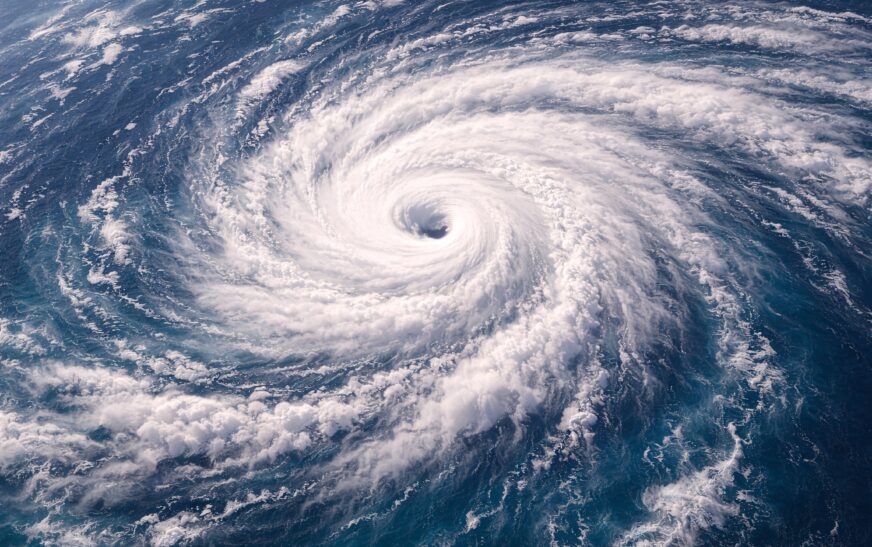
The history of natural disasters is filled with events, among which some were quite spectacular and terrifying in particular. Such types of disasters include hurricanes. Those represent rather complex atmospheric conditions when air masses are rotated in a certain area. It should be mentioned that hurricanes attract lots of people’s attention for many centuries due to numerous reasons, including possible damages and loss of lives they can cause. By learning everything about the processes occurring during hurricanes’ development and studying their features, one can prepare adequately for these dangerous phenomena.
The Process of Formation of Hurricanes
As any other natural phenomenon, hurricanes do not occur randomly but follow a specific pattern of development. It means that the main prerequisites to the formation of hurricanes should be mentioned first of all. First of all, hurricanes are formed over warm ocean waters in the Atlantic, Pacific, and Indian oceans. They use heat and moisture from those seas and oceans. When the sea surface temperature becomes not less than 26.5°С (80°F) and there is a pre-existing weather condition, such as a tropical wave or a low-pressure system, hurricanes can start developing. Due to the influence of the Coriolis effect caused by the rotation of the Earth, hurricanes tend to rotate in order to acquire their specific forms.
It appears that hurricane formation implies various processes, each of which is equally important when analyzing hurricanes. For instance, winds’ speed or direction changing with elevation (i.e., wind shear) is an obstacle to hurricane rotation and prevents a storm from being called a hurricane. It should also be admitted that the instability of the atmosphere may play a crucial role in hurricane formation since it is capable of generating updrafts and downdrafts needed in the hurricane creation process.
The Structure of a Hurricane
When speaking of hurricanes’ structures, they are rather unique, which distinguishes hurricanes from other types of weather phenomena. Every hurricane consists of such components as the eye, the eyewall, and rainbands. The eye is situated in the center of the storm; it is characterized by calms and clear weather. The eye is surrounded by a wall composed of thick clouds and powerful winds called the eyewall. This feature represents the core of hurricane and provides information about its strength and intensity as it contains the heaviest rainfalls. The last component, which is the rainbands, includes areas of rain and thunderstorms located in spirals outside the eye.
Analyzing the structure of hurricanes, it is possible to conclude that it is rather complex. In general, such elements as winds’ strength and direction, temperature and humidity of the air, as well as a pre-existing weather disturbance, are taken into account.
Hurricanes’ Impacts
There is a great variety of impacts hurricanes can inflict. For instance, strong winds and rainfall associated with hurricanes may destroy buildings and uproot trees. Storm surges resulting from hurricanes’ activities may lead to flooding in the nearby territory. Moreover, hurricanes affect communities and economies rather significantly, causing damages that may amount up to billions of dollars. Therefore, it is rather important to pay attention to their effects as their consequences may affect people’s lives considerably and for a long period of time.
Hurricanes’ impacts are diverse; therefore, one should be ready for various negative outcomes when considering the possibility of this type of disaster. In addition to the direct consequences of hurricanes, scientists also consider the social and economic impacts of these storms.
The Science of Hurricanes
Speaking of hurricanes’ science, it is necessary to admit that this knowledge plays a key role in the proper hurricane forecasting as it explains their formation, processes, and behaviors. In spite of numerous studies conducted so far, the issue remains rather complicated since there is still much to investigate. However, nowadays it is already possible to make hurricane predictions with the help of computer models and satellite images. Scientists work hard in order to learn more about this complicated weather phenomenon.
To study hurricanes properly, it is necessary to combine efforts of specialists belonging to different disciplines, including meteorology, oceanography, and geology. Such scientists can analyze complex relations between the atmosphere, ocean, and land involved in hurricane development.
Researches of Hurricanes
At present, numerous researches devoted to the issue under discussion are carried out. In particular, hurricane modeling is rather topical nowadays, and researchers try to create more accurate and dependable models of hurricanes. Additionally, there is a group of experts specializing in hurricane forecasting and trying to develop efficient forecast methods. Social and economic aspects of hurricanes are not forgotten either; therefore, one can see a wide range of researches focusing on those aspects of hurricanes.
In conclusion, it should be stated that the science of hurricanes is developing dynamically, and one can expect lots of interesting findings in the nearest future.